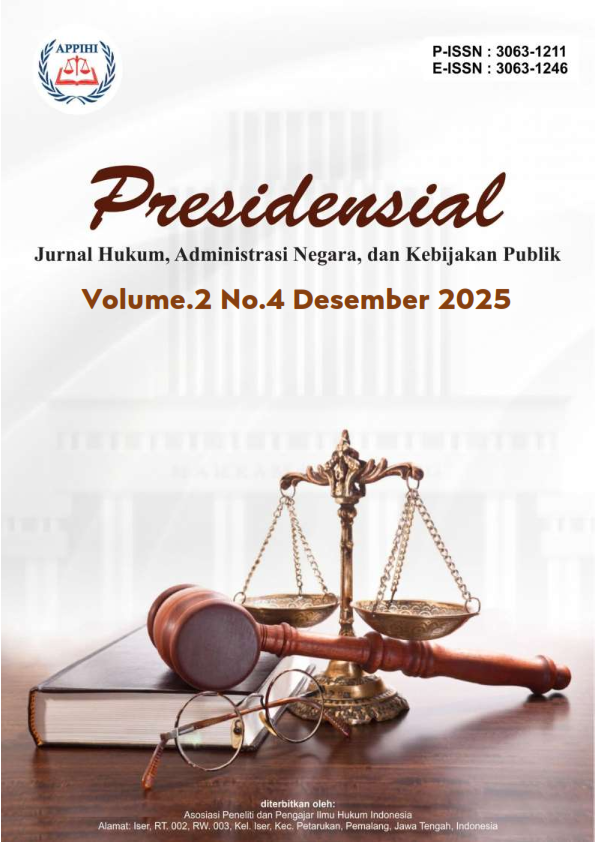
Tinjauan Yuridis Hak Karyawan PT Kuoni Indonesia dalam Hal Terjadinya Pemutusan Hubungan Kerja Berdasarkan Undang – Undang Nomor 13 Tahun 2003
DOI:
https://doi.org/10.62383/presidensial.v2i4.1424Keywords:
Compensation, Employment, Job Creation, Layoffs, WorkersAbstract
An employment relationship is a relationship between a worker and an employer or entrepreneur involving work, wages, and orders. One outcome of this employment relationship is termination of employment. To create a just and prosperous society based on Pancasila and the 1945 Constitution, the government has enacted laws concerning termination of employment, such as Law No. 13 of 2003 concerning Manpower, Law No. 11 of 2020 concerning Job Creation, and Government Regulation No. 35 of 2021 concerning Fixed-Term Employment Agreements, Outsourcing, Working and Rest Hours, and Termination of Employment. This research uses a normative legal method, namely examining the law as it exists or should exist, or the law in books. The research was conducted by analyzing applicable laws and regulations, using library materials or secondary data covering primary, secondary, and tertiary law. Termination of employment is the right of both parties, namely workers and employers. Both parties can terminate the employment relationship according to their respective situations or conditions. This issue often generates debate because each party has different perspectives and arguments regarding termination of employment. As a result, the amount of compensation workers receive in practice also varies. Comparing Law No. 13 of 2003, Law No. 11 of 2020, and Government Regulation No. 35 of 2021 concerning termination of employment, it is clear that the Employee Rights Act No. 13 of 2003 provides more compensation than the Job Creation Law. Therefore, in practice, many companies, including PT Kuoni Indonesia, seek ways to reduce their compensation obligations under the pretext of negotiating with employees.
Downloads
References
Asyhadie, Z. (2013). Hukum kerja (hukum ketenagakerjaan bidang hubungan kerja). RajaGrafindo Persada.
Badan Pembinaan Hukum Nasional. (n.d.). Peraturan perundang-undangan. https://peraturan.bpk.go.id
Badan Pengembangan dan Pembinaan Bahasa. (n.d.). Kamus Besar Bahasa Indonesia. https://kbbi.kemdikbud.go.id
Binus Accounting. (2023, April 3). Pemutusan hubungan kerja (PHK): Ini dia aturan hukumnya. https://accounting.binus.ac.id/2023/04/03/pemutusan-hubungan-kerja-phk-ini-dia-aturan-hukumnya/
Hukumonline. (n.d.). Cara hitung pesangon. https://www.hukumonline.com/klinik/a/cara-hitung-pesangon-lt515b7ec90fe0c/
Ibrahim, J. (2005). Teori dan metode penelitian hukum normatif. Bayumedia Publishing.
Karim, A. (2009). Dasar-dasar hukum ketenagakerjaan Indonesia. Citra Aditya Bakti.
Kasim, U. (2004). Hubungan kerja dan pemutusan hubungan kerja. Informasi Hukum, 2.
Mainake, Y. (2021). Judicial review klaster ketenagakerjaan undang-undang bidang hukum. Info Singkat: Isu Aktual dan Strategis Pusat Penelitian Badan Keahlian DPR RI, XIII(8).
Maringan, N. (2015). Tinjauan yuridis pelaksanaan pemutusan hubungan kerja (PHK) secara sepihak oleh perusahaan menurut Undang-Undang Nomor 13 Tahun 2003 tentang Ketenagakerjaan. Jurnal Ilmu Hukum Legal Opinion, 3(3).
Marzuki, P. M. (2005). Penelitian hukum (Edisi revisi). Kencana.
Muhammad, A. (2003). Hukum dan penelitian hukum. Citra Aditya Bakti.
Peraturan Pemerintah Republik Indonesia Nomor 35 Tahun 2021 tentang Perjanjian Kerja Waktu Tertentu, Alih Daya, Waktu Kerja dan Waktu Istirahat, serta Pemutusan Hubungan Kerja.
Putri, A. R. H., Sonhaji, & Solechan. (2016). Perlindungan hukum terhadap hak-hak pekerja yang terkena pemutusan hubungan kerja akibat efisiensi perusahaan berdasarkan Undang-Undang Nomor 13 Tahun 2003 tentang Ketenagakerjaan di Kota Semarang. Diponegoro Law Review, 5(2).
Sastrohadiwiryo, S. (2003). Manajemen tenaga kerja Indonesia: Pendekatan administrasi dan operasional. Bumi Aksara.
Soekanto, S., & Mamudji, S. (2010). Penelitian hukum normatif: Suatu tinjauan singkat. Rajawali Pers.
Undang-Undang Dasar Negara Republik Indonesia Tahun 1945.
Undang-Undang Republik Indonesia Nomor 11 Tahun 2020 tentang Cipta Kerja.
Undang-Undang Republik Indonesia Nomor 13 Tahun 2003 tentang Ketenagakerjaan.
Universitas Diponegoro. (n.d.). Diponegoro Law Review. https://ejournal3.undip.ac.id/index.php/dlr/
Uwiyono, A. (2014). Asas-asas hukum perburuhan. Rajawali Pers.
Wijayanti, A. (2013). Hukum ketenagakerjaan pasca reformasi. Sinar Grafika.
Zulhayati, S. (2010). Pengaruh pemutusan hubungan kerja terhadap karyawan perusahaan. Jurnal Pendidikan Sosiologi dan Humaniora, 1.
Downloads
Published
How to Cite
Issue
Section
License
Copyright (c) 2025 Presidensial: Jurnal Hukum, Administrasi Negara, dan Kebijakan Publik

This work is licensed under a Creative Commons Attribution-ShareAlike 4.0 International License.