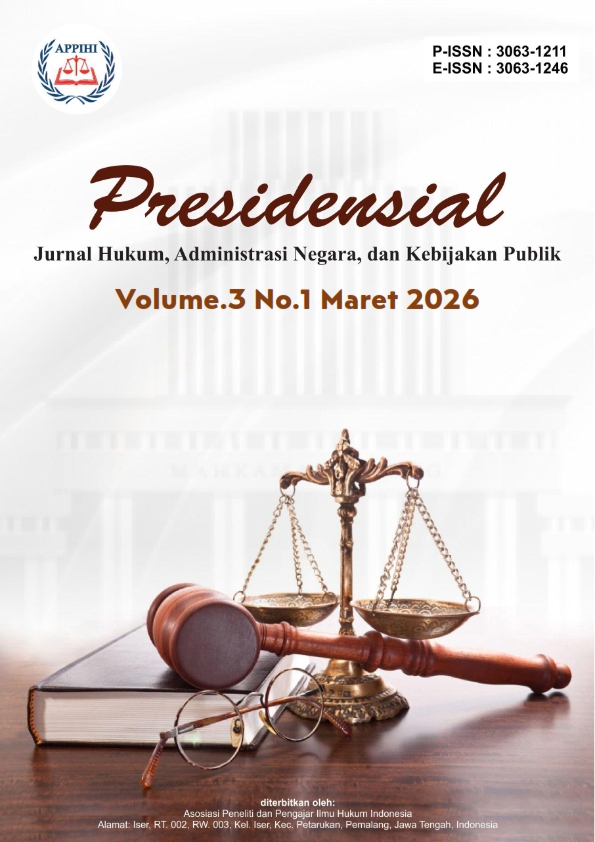
Transformasi Pengelolaan Parkir Berlangganan 2027 Analisis Maslahah Mursalah terhadap Keadilan Distribusi Ekonomi
DOI:
https://doi.org/10.62383/presidensial.v3i1.1572Keywords:
Distributive Justice, Maslahah Mursalah, Parking Policy, STNK 2027, Subscription ParkingAbstract
The policy plan to integrate parking fees into the Vehicle Registration Certificate (STNK), scheduled for nationwide implementation in 2027, has generated debate regarding contractual validity and fiscal justice. From the perspective of Islamic Economic Law, the transformation from a conventional pay-per-use retribution system to an annual prepaid system raises issues related to mutual consent (an-taradin) and the certainty of service benefits. This study aims to analyze the 2027 subscription parking policy using the framework of Maslahah Mursalah and the principle of distributive economic justice to assess its legitimacy as an instrument of public welfare. This research uses a normative legal method with conceptual and statutory approaches. Literature data are analyzed qualitatively through deductive reasoning to derive legal conclusions from general principles of Islamic economics in relation to contemporary fiscal policy. The findings indicate that the policy contains elements of Maslahah Mursalah, particularly in improving bureaucratic efficiency and preventing state revenue leakage (sadd adz-dzari'ah). However, from the perspective of distributive justice, the policy may contain elements of dzulm (injustice) if it is not supported by fair tariff segmentation. Without guaranteed service availability for all payers, mandatory annual parking fees risk being categorized as akl al-amwal bi al-bathil (unlawful appropriation of wealth). Therefore, a zoning-based tariff system is recommended to ensure fairness between obligations and benefits.
Downloads
References
Akuntansi, P. S., Ekonomi, F., Bisnis, D. A. N., & Mukti, U. W. (2025). Pendapatan asli daerah Kota Cimahi periode tahun 2021–2024.
Alfirdausi, M. R. (n.d.). Pemungutan retribusi dalam Peraturan Daerah Kota Yogyakarta Nomor 1 Tahun 2020.
Asrina. (2022). Pemikiran Yusuf al-Qardhawi: Fikih zakat (studi komparatif mengenai status dan filsafat zakat berdasarkan Al-Qur’an dan hadis).
Dm, M. Y., Putra, A. K., Hasibuan, R. Y., & Delpian, S. (2025). Faktor-faktor yang mempengaruhi penegakan hukum dalam masyarakat. 5(4), 2866–2871.
Fatwa, S., Mui, D. S. N., & Perkembangan, T. (2019). Istinbáth. 18(2), 425–450.
Hidayat, A. S., & Pratama, R. (2024). Reorientasi kebijakan retribusi daerah pasca pemberlakuan UU HKPD: Tantangan implementasi dan aspek keadilan fiskal. Jurnal Administrasi Publik dan Kebijakan.
Manajemen, J., Kewirausahaan, B., Pramudita, N. R., & Kamela, H. (2026). Pendapat masyarakat tentang efektivitas penanganan parkir liar dalam meningkatkan pendapatan asli daerah Kota Medan.
Metodologi, P., & Hukum, P. (2024). Metodologi penelitian hukum.
Mufid, A., & Pasya, J. (2025). A political review of zakat management regulations. 6(8), 1–25.
Rachmat, L. B. (2025). Efektivitas implementasi pemungutan retribusi tempat khusus parkir di luar badan jalan berdasarkan Peraturan Wali Kota Semarang Nomor 61 Tahun 2024.
Santika, D. (2019). Tinjauan hukum Islam terhadap pembayaran sewa parkir secara fluktuatif.
Sofia, F., Faj, N., & Wibawani, S. (2024). Implementasi kebijakan parkir berlangganan di Kabupaten Tuban. 7, 182–189.
Tribuani, L. P., Saebani, B. A., & Saptaji, A. (2025). Tinjauan siyasah maliyah terhadap pelaksanaan retribusi parkir dan kontribusinya kepada pendapatan asli daerah. 7(4), 3062–3077.
Wati, K., Suhatmi, E. C., Aini, A. N., Akuntansi, P., Hukum, F., Duta, U., & Surakarta, B. (2024). Strategi optimalisasi digitalisasi perpajakan di Indonesia: Tantangan dan peluang di era industri 5.0. 590–597.
Widiarty, W. S. (n.d.). Buku ajar.
Downloads
Published
How to Cite
Issue
Section
License
Copyright (c) 2026 Presidensial: Jurnal Hukum, Administrasi Negara, dan Kebijakan Publik

This work is licensed under a Creative Commons Attribution-ShareAlike 4.0 International License.