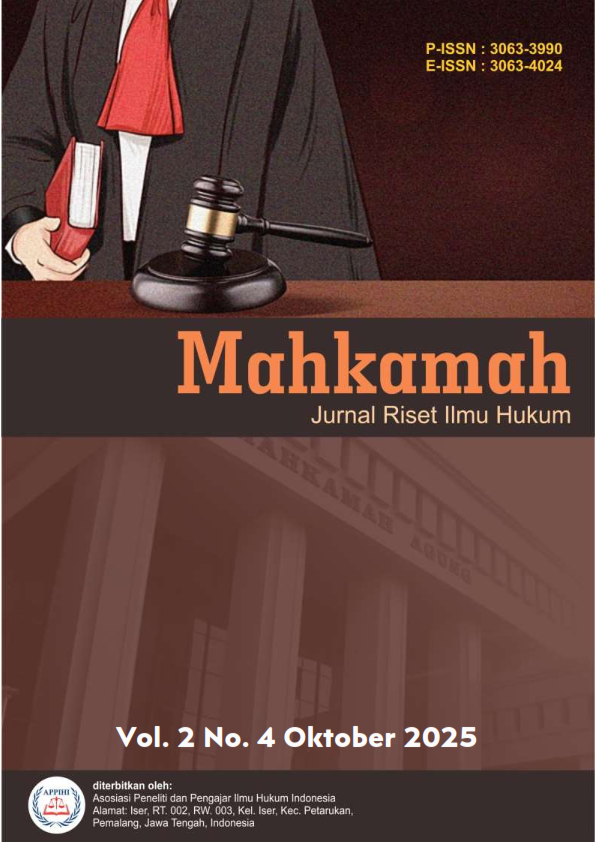
Pengibaran Bendera One Piece dan Produksi Musuh Imajiner: Pendekatan Kriminologi Kritis atas Politik Ketakutan
DOI:
https://doi.org/10.62383/mahkamah.v2i4.1148Keywords:
Critical Criminology, Flag, One Piece, Politics of FearAbstract
The state has a mandate to guarantee citizens' freedom of expression by protecting symbolic representations in public spaces. However, legal construction in Indonesia tends to use the law as a tool to limit visual interpretation, including popular cultural symbols such as the One Piece flag. This study aims to explain two main aspects of the mechanism of symbol criminalization: the state's construction of symbols as threats without any basis in actual violations, and the political use of fear through the production of imaginary enemies. The research method employed a qualitative approach with a conceptual approach. The results show that the state's interpretation of visual symbols rests not on the legality of the action, but on controlling the potential meanings that develop outside the official narrative. Within this construction, the law operates as a filtering mechanism for forms of articulation deemed inconsistent with the state's ideological interests. This strategy shifts the focus from concrete violations to the surveillance of social imagination. Thus, the criminalization of symbols occurs not because of their factual content, but because they open up pathways of solidarity that cannot be institutionally controlled. A critical criminological approach demonstrates that the state uses the law to enforce symbolic domination through techniques of controlling meaning within a democratic regime that formally promises freedom of expression.Downloads
References
Aaronson, E., & Shaffer, G. (2021). Defining Crimes in a Global Age: Criminalization as a Transnational Legal Process. Law & Social Inquiry, 46(2), 455–486.
Angretnowati, Y., & Karolus, M. L. (2022). Negara, Gerakan Islam Pasca-Fundamentalis dan Masa Depan Demokrasi di Indonesia: Kekuasaan Simbolik dan Upaya Konsolidasi. Politika: Jurnal Ilmu Politik, 13(2), 369–393.
Beaman, L. G. (2021). Our Culture, Our Heritage, Our Value: Whose Culture, Whose Heritage, Whose Values? . Canadian Journal of Law and Society, 36(1), 203–223.
Bouallegui, B., Gubsi, M., & Elloumi, A. (2025). Visual Symbols as Tool of Cultural and Environmental Resistance: The Example of the Movement “Sakkar Al-Siyap” (Close the Siape) of Sfax-Tunisia. International Journal of Research and Innovation in Social Science, 9(6), 3011–3021.
Btr, T., Palapa, A., & Saifudin, I. (2024). Pidana Pengawasan dalam Perspektif Pembaharuan Hukum Pidana di Indonesia. Syntax Idea, 6(7), 3131–3144.
Garza, Y. B. de la. (2020). The Meek and the Mighty: Two Models of Oppression. European Journal of Political Theory, 21(3), 491–513.
Goldbach, T. S. (2021). Building the Aboriginal Conference Settlement Suite: Hope and Realism in Law as a Tool for Social Change. Law & Social Inquiry, 46(1), 116–152.
Hörnqvist, M. (2019). Neoliberal Security Provision: Between State Practices and Individual Experience. Punishment & Society, 22(2), 227–246.
Huang, T. (2023). How Art Semiotics Affects Our Behaviour and Judgement. Art and Society, 2(5), 46–49.
Iqbal, M., Syamsuri, Atmaja, T. S., Bistari, & Purnama, S. (2025). Penguatan Nilai-Nilai Karakter Nasionalisme Remaja Melalui Tokoh Bajak Laut Topi Jerami dalam Anime One Piece. Journal of Education, 7(2), 10392–10399.
Kadir, Z. K. (2024). Psychoanalytic and Crime: Is Freud’s Theory Still Applicable in Criminological Research? Media Keadilan: Jurnal Ilmu Hukum, 15(2), 95–110.
Kadir, Z. K. (2025). Kriminologi Reaksioner: Sayap Kanan, Moralitas, dan Kriminalisasi Budaya Pop dalam Era Post-Truth. Jurnal Intelek Insan Cendikia, 2(5), 10108–10121.
Lee, J., Toth, B., & Carter, E. (2025). Post-Truth Politics and Legal Epistimology: The Erosion of Legal Facts in Polarized Democracies. Interdisciplinary Studies in Society, Law, and Politics, 4(2), 248–264.
Mihai, C. (2023). Media, Religion, and the Public Sphere. Religions, 14(1253), 1–14.
Muizuddin, M. S., Cahyo, S. B., Muzaki, R. A., & Virdyanto, T. V. (2024). Simbol-Simbol Keagamaan dan Budaya dalam Identitas Kolektif Desa Tunjungrejo melalui Perspektfi Sosiologi Budaya. Jurnal Insan Pendidikan Dan Sosial Humaniora, 2(3), 133–144.
Pomeroy, C. (2025). The Damocles Delusion: The Sense of Power Inflates Threat Perception in World Politics. International Organization, 79(1), 1–35.
Sik, D. (2019). Towards a Social Theory of Fear: A Phenomenology of Negative Integration. European Journal of Social Theory, 23(4), 512–531.
Silitonga, T. B. (2020). Tantangan Globalisasi, Peran Negara, dan Implikasinya terhadap Aktualisasi Nilai-Nilai Ideologi Negara. Jurnal Civics: Media Kajian Kewarganegaraan, 17(1), 15–28.
Tabor, C. (2022). Book Review: Seeing Justice: Witnessing, Crime, and Punishment in Visual Media. Visual Communication, 24(2), 529–531.
Downloads
Published
How to Cite
Issue
Section
License
Copyright (c) 2025 Mahkamah : Jurnal Riset Ilmu Hukum

This work is licensed under a Creative Commons Attribution-ShareAlike 4.0 International License.