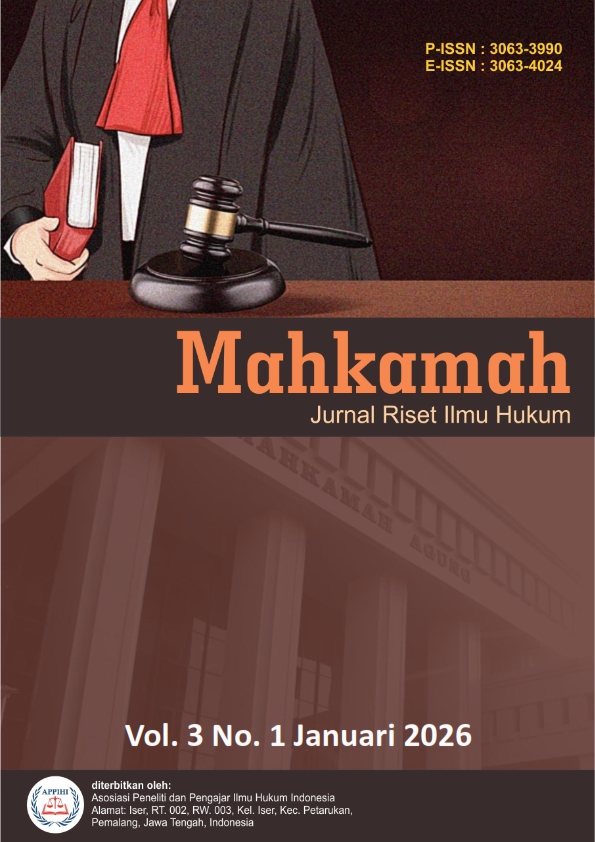
Perlindungan Hukum dan Kepastian Hukum terhadap Perdagangan Data Pribadi dalam UU PDP
DOI:
https://doi.org/10.62383/mahkamah.v3i1.1488Keywords:
Consent, Criminal Offenses, Data Controllers, Data Subjects, Privacy RightsAbstract
Article 20 of the Personal Data Protection Law (PDP Law) normatively regulates the protection of data subjects and constitutes a pivotal provision that underscores the principle of consent as the legal basis for the processing of personal data for commercial purposes. This normative framework safeguards individuals’ right to privacy, encompassing the validity of explicit consent, the right to withdraw such consent, and the accountability of data controllers. In parallel, Articles 65 to 70 of the PDP Law substantively establish various categories of criminal offenses within the context of personal data protection. These include the unlawful acquisition, disclosure, processing, falsification, and utilization of personal data. Collectively, these provisions reflect the State’s commitment to ensuring criminal legal protection against violations of personal data.This research adopts a doctrinal legal methodology with a descriptive-normative approach to address two primary issues: First, to examine and identify the scope of legal protection concerning the trade of personal data under the PDP Law; and Second, to assess and determine the degree of legal certainty afforded to the trade of personal data within the framework of the PDP Law.Notwithstanding the protective intent embodied in Article 20—particularly concerning the commercial use of personal data—this provision gives rise to legal uncertainty due to the absence of comprehensive regulatory clarity on several critical aspects. Similarly, Articles 65 to 70 continue to exhibit significant legal ambiguities, particularly with respect to the constituent elements of offenses, the definition of harm, corporate liability, regulatory overlap with other legislative instruments, and the lack of clear enforcement mechanisms and implementing institutions.
Downloads
References
Ali, M. (2011). Dasar-Dasar Hukum Pidana. Jakarta: Sinar Grafika.
Manan, B. (2004). Hukum Positif Indonesia (Satu Kajian Teoritik). Cetakan Pertama. Yogyakarta: FH UII Press.
Prastyanti, R. A. (2025). Monograf Perlindungan Data Pribadi Konsumen Penggunaan Tranksaksi Elektronik. Pekalongan: NEM.
Priyatno, M. d. (2010). Pertanggungjawaban Pidana Korporasi. Jakarta: Kencana.
Purwati, A. (2020). Metode Penelitian Hukum Teori Dan Praktek. Surabaya: Jakad Media Publishing.
R, Y. M. (2023). Tinjauan Yuridis Terhadap Efektivitas Penanganan Kejahatan Siber Terkait Pencurian Data Pribadi Menurut Undang-Undang No. 27 Tahun 2022 oleh KOMINFO. UNES Law Review.
Remmelink, J. (2003). Hukum Pidana: Komentar Atas Pasal-Pasal Terpenting dari Kitab Undang Undang Hukum Pidana Belanda dan Padanannya dalam Kitab Undang-Undang Hukum Pidana Indonesia. Jakarta: PT Gramedia.
S, A. &. (2007). Ilmu Perundang-Undangan . Yogyakarta: PT. Kanisius.
Soekanto, P. P. (1982). Perihal Kaidah Hukum. Bandung: Alumni.
Subekti. (1984). Hukum Perjanjian. Jakarta: PT Intermasa.
Suriaatmadja, R. d. (2023). Perlindungan Hukum Atas Kebocoran Data Pribadi Konsumen PT PLN Dihubungkan Dengan Hak Atas Keamanan Pribadi Ditinjau Dari Undang-Undang Nomor 27 Tahun 2022 Tentang Perlindungan Data Pribadi. Bandung Conference Series .
Syahrani, R. (1999). Rangkuman Intisari Ilmu Hukum. Bandung: Citra Aditya.
Downloads
Published
How to Cite
Issue
Section
License
Copyright (c) 2026 Mahkamah : Jurnal Riset Ilmu Hukum

This work is licensed under a Creative Commons Attribution-ShareAlike 4.0 International License.