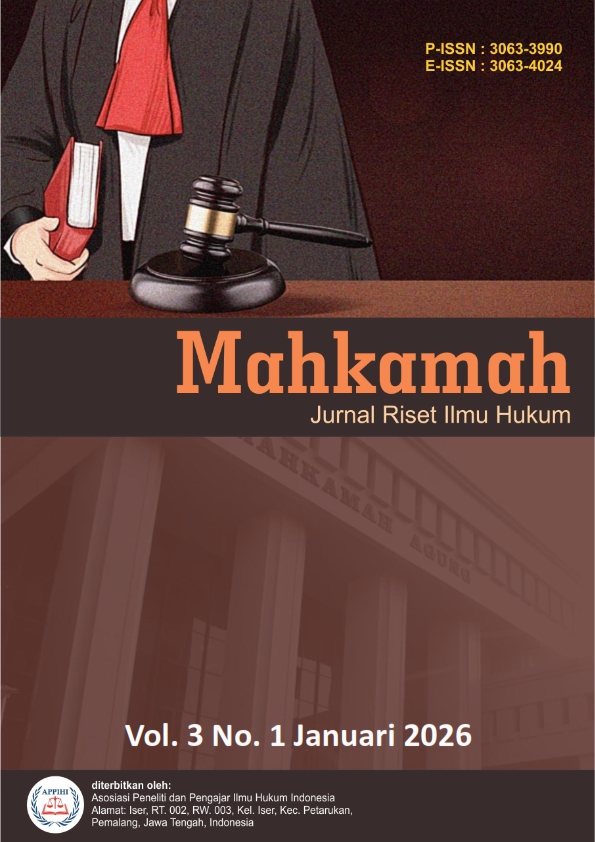
Kedudukan Penyandang Disabilitas dalam Melakukan Pembuatan Perjanjian Pasca Judicial Review Pasal 433 KUHPerdata
DOI:
https://doi.org/10.62383/mahkamah.v3i1.1512Keywords:
Agreement, Competence, Guardianship, Legal Subject, Normative JurisprudenceAbstract
This study discusses the position of persons with disabilities, especially those with mental and intellectual disabilities, in carrying out legal actions following the judicial review of Article 433 of the Civil Code through the Constitutional Court Decision Number 93/PUU-XX/2022. Prior to this amendment, Article 433 of the Civil Code used discriminatory terms and automatically placed persons with disabilities under guardianship, thereby eliminating their legal capacity as independent legal subjects. This Constitutional Court decision changed the phrase "must be guarded" to "can be guarded" and emphasized that the placement of guardianship can only be made based on a competent medical diagnosis. The research method used is normative juridical through a statutory approach and court decisions. The results of the study show that the change in norms restores the constitutional rights of persons with disabilities, including the right to autonomy, equality before the law, and protection from discrimination. In addition, this change directly affects the requirements for capacity in making agreements according to Article 1320 of the Civil Code, so that persons with mental disabilities who have the capacity are still considered capable of acting. Therefore, this decision is an important step in realizing a legal system that is more inclusive, just and respects the dignity of people with disabilities.
Downloads
References
Agung Barok Pratama, & Muhammad Yusron. (2024). Advokasi hak pilih penyandang disabilitas mental di Kabupaten Batang. AKM Aksi Kepada Masyarakat, 5(1), 265. https://doi.org/10.36908/akm.v5i1.1109
Bachtiar. (2019). Metode penelitian hukum. Unpam Press.
Francois Geny Ritonga, & Mawar Sitohang. (2024). Pembaharuan ketentuan pengampuan dalam Kitab Undang-Undang Hukum Perdata dalam mewujudkan pelindungan hukum. Honeste Vivere, 34(2), 173. https://doi.org/10.55809/hv.v34i2.320
Haliza Azzahra, Sunny Ummul Firdaus, & Achmad. (2025). Analisis putusan Mahkamah Konstitusi Nomor 93/PUU-XX/2022 terhadap pengampuan bagi penyandang disabilitas mental. Res Publica, 9(3), 170.
Klinik Hukumonline. (2025). Kriteria orang di bawah pengampuan menurut KUH Perdata. Retrieved on October 8, 2025, from https://www.klinik.hukumonline.com/
Mahlil Adriaman, dkk. (n.d.). Hukum perdata (Ctk 1). CV Gita Lentera.
Ni Ketut Pirda Juwisa Badra, & Anak Agung Ketut Sukranatha. (2022). Problematika penyandang disabilitas mental dalam perspektif hak asasi manusia. Jurnal Kertha Wicara, 11(5), 1092-1101. https://doi.org/10.24843/KW.2022.v11.i05.p14
Nurkholis. (2022). Penetapan usia dewasa cakap hukum berdasarkan undang-undang dan hukum Islam. Jurnal Pemikiran Hukum Dan Hukum Islam, 1(8), 76. https://doi.org/10.21043/yudisia.v8i1.3223
PJS-IMHA. (2025). Pers release: Judicial review pasal 433 KUHPerdata menanti Mahkamah Konstitusi mengembalikan kapasitas hukum penyandang disabilitas mental. Retrieved on November 20, 2025.
Putusan Mahkamah Konstitusi Nomor 93/PUU-XX/2022 tentang perubahan Pasal 433 KUHPerdata.
Ridwan Khairandy. (2014). Hukum kontrak Indonesia dalam presfektif perbandingan (Ctk ke-2). Yogyakarta.
Satjipto Raharjo. (2014). Ilmu hukum (Ctk ke-8). Bandung.
Sidang pendahuluan judicial review Pasal 433 KUHPerdata. (2025). Retrieved on November 8, 2025.
Zainudin Ali. (2019). Metode penelitian hukum (Ctk ke-11). Sinar Grafika.
Zennia Amaida, & Moch. Najib Imanullah. (2021). Perlindungan hukum preventif dan represif bagi pengguna uang elektronik dalam melakukan transaksi tol nontunai. Privat Law, 9(1), 222.
Downloads
Published
How to Cite
Issue
Section
License
Copyright (c) 2026 Mahkamah : Jurnal Riset Ilmu Hukum

This work is licensed under a Creative Commons Attribution-ShareAlike 4.0 International License.